

Have you ever wondered what shapes our mental health?
When you think about mental health, do you often focus on your inner world -thoughts and feelings and ask the question, “What’s happening?”. While understanding your thoughts, feelings, and behaviours is important, they are only part of the picture. A systems perspective helps us understand that mental health is shaped by the many environments we live in and interact with every day, sometimes in ways we might not immediately notice. In doing so, we can begin asking a different and more helpful question: “What’s happening around me, and how is it affecting me?”
Ecological Systems Theory
Using ideas from Ecological Systems Theory, developed by Urie Bronfenbrenner, we can understand people as part of a wider, interconnected environment. Rather than viewing a person and their mental health in isolation, Bronfenbrenner’s layers of the social environment show how we are influenced by different systems - from our immediate relationships to wider social and cultural contexts. These layers interact with each other all play a role in shaping how people think, feel, and cope in daily life, ultimately influencing wellbeing.
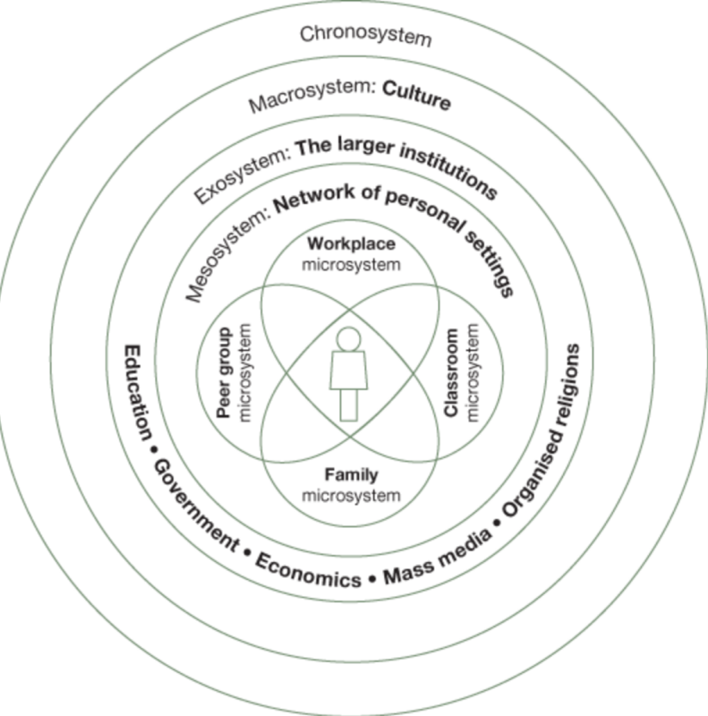
Ecological Systems Theory breaks a person’s environment into different layers of systems:
- Microsystem
This is the closest and most immediate environment. It includes the people and places we interact with every day - such as family, friends, school, or work. These relationships often have the most direct impact on how we feel and cope. - Mesosystem
This layer is about the connections between parts of our microsystem. For example, how our work life and home life interact, or how communication between family and school or services influences our experience. - Exosystem
These are settings that don’t involve us directly but still affect our life. For example, a partner’s workplace stress, local services, institutions, or community decisions that influence our daily circumstances. - Macrosystem
This includes the wider cultural and societal context - things like social values, cultural beliefs, economic systems, and attitudes toward mental health. These shape how we experience and talk about wellbeing. - Chronosystem
This layer looks at how time and life changes influence mental health, such as moving to a new place, starting or changing jobs, beginning or ending relationships, becoming a parent, or experiencing loss. It also includes broader events that affect whole communities or societies, such as economic changes, natural disasters, or global events.
Feedback Loops
What are feedback loops? Feedback loops is the core idea of systems thinking. They are ongoing cycle where different parts of our environment - across the microsystem, mesosystem, exosystem, macrosystem, and chronosystem - influence each other and shape our thoughts, feelings, and behaviours over time. Instead of one event directly causing one outcome, changes in one area can affect another, which then feeds back and influences the original situation again.
For example:
- Stress at work affects someone’s personal and family life, including sleep and relationships. Poor sleep and strained relationships then make it harder to cope the next day, increasing stress levels again and continuing the cycle.
- A difficult or traumatic life event can also affect a person’s sense of safety and wellbeing. This may then influence their work, relationships, daily routines, and emotions over time.
- Feeling anxious may lead someone to avoid social situations, which can increase feelings of isolation and then make anxiety stronger over time.
- On the other hand, positive experiences can also create feedback loops. Supportive relationships with family increase positive and good mood, it then makes a person feel happier and more confident. which encourages stronger connections with others at work or personal life and builds greater support over.
What does systems perspective mean for you?
Shifting thinking pattern from linear thinking to systems thinking
Have you ever found yourself thinking:
- “I’m stressed because I can’t cope.”
- “I’m stressed because of too much workload at work.”
- “It’s my fault things feel difficult because I can’t finish my tasks.”
- “I should be coping better.”
- “I should have done that.”
This is what we call linear thinking, where we link one cause directly to one outcome and often place responsibility entirely on ourselves.
With a systems perspective, we are more aware of feedback loops and develop systems thinking:
- “My stress is influenced by many factors around me.”
- “What’s happening in my environment and relationships?”
- “I feel stressed because of a heavy workload, and this may be due to short staffing at work. Maybe I can talk to my manager about it.”
- “How are different parts of my life connected?”
Looking beyond the individual
When we take a systems perspective, we start to look beyond the individual and consider the wider picture. This can help us:
- Reduce self-blame
- Recognise external stressors that may be impacting wellbeing
- Improve communication and understanding in relationships
- Support more meaningful and lasting change, rather than only focusing on “fixing” yourself
Practical Actions You Can Take
- Pause and reflect on patterns - Notice when your stress or mood changes and what else is happening around you at the same time.
- Think beyond “it’s just me” - Gently ask: What external factors might be influencing how I feel right now?
- Notice connections in your life - Consider how work, relationships, social network, and environment might be interacting with each other.
- Strengthen supportive connections - Reach out, communicate, or reconnect with people or spaces that help you feel grounded.
- Make small environmental changes - Even small adjustments, for example, like routines, boundaries, or workload discussions can positively affect the bigger system.
This is a brief introduction to a systems theory and systems thinking perspective, and how our mental health and wellbeing are shaped by the environments and connections around us. This broader view can help us better understand our experiences in a more balanced and compassionate way.
If you would like to learn more, please contact EASA.
Resources:
Harms, L., & Connolly, M. (2023). Systems theories: Ecological and crisis intervention approaches. In Harms, L., & Connolly, M. (Ed.), Social work: From theory to practice (4th ed., pp. 64-91). Cambridge University Press. Eriksson, M., Ghazinour, M. & Hammarström, A (2018). https://doi.org/10.1017/9781009091848
Different uses of Bronfenbrenner’s ecological theory in public mental health research: what is their value for guiding public mental health policy and practice?. Soc Theory Health 16, 414 - 433. https://doi.org/10.1057/s41285-018-0065-6